
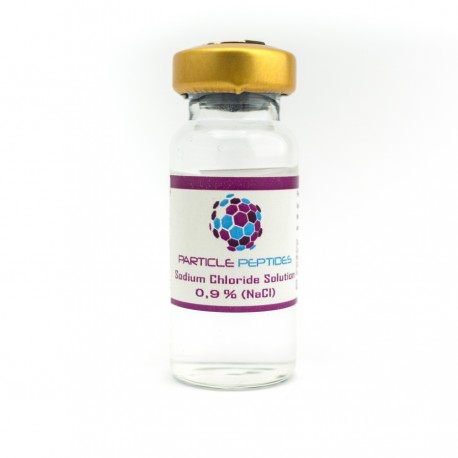
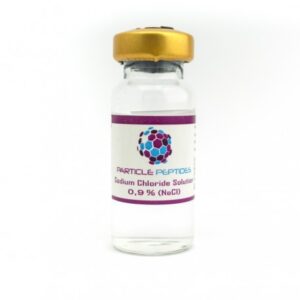
Sodium Chloride 0.9% 10ml
€9.99
Bacteriostatic Saline — Proven NaCl Research Reconstitution 10ml
Bacteriostatic saline — sodium chloride 0.9% solution — is a physiologically isotonic diluent formulated for the reconstitution of lyophilised peptides that require a saline buffer environment rather than plain water. The 0.9% NaCl concentration is isotonic with human physiological fluid — a critical property for research applications where peptide solubility, stability and biological activity are dependent on ionic strength. Supplied in a 10ml bottle, this product is manufactured and supplied for scientific research and development purposes only.
⚠️ Research Use Only. This product is intended exclusively for in-vitro scientific research. It is not approved for human or animal consumption, clinical injection, therapeutic application or any use on humans or animals.
Table of Contents
- Product Specifications
- Isotonic Saline in Research Context
- When to Use Saline vs Bacteriostatic Water
- Peptide Reconstitution Best Practices
- Storage and Handling
- FAQ
Product Specifications
| Parameter | Detail |
|---|---|
| Product | Sodium Chloride 0.9% Solution |
| Common Designation | Bacteriostatic Saline / Normal Saline |
| Volume | 10ml |
| Unit | 1 Bottle |
| Physical Appearance | Transparent liquid |
| NaCl Concentration | 0.9% (9g/L) |
| CAS Number | 7647-14-5 (NaCl) |
| Tonicity | Isotonic |
| Intended Use | Lyophilised peptide reconstitution — research only |
Isotonic Saline in Research Context
Injectable saline solution in the clinical context and saline for injection in research both refer to the 0.9% NaCl concentration that produces isotonicity with physiological fluid. This isotonicity is the defining property that makes saline the preferred reconstitution medium for peptide research compounds that are specified for NaCl reconstitution rather than plain water.
The ionic environment provided by 0.9% NaCl is relevant to multiple peptide stability considerations. Many peptides exhibit improved solubility, reduced aggregation tendency and better maintenance of active conformation in an ionic buffer environment compared to plain water. For peptides specified to reconstitute in NaCl — such as CJC-1295 DAC, DSIP, ipamorelin, GHRP-6 and others in this catalogue — using plain bacteriostatic water rather than the specified injectable saline may compromise reconstitution quality and research reproducibility.
When to Use Saline vs Bacteriostatic Water
The choice between bacteriostatic saline and bacteriostatic water for peptide reconstitution should be determined by the specific reconstitution instructions for each peptide compound:
Use bacteriostatic saline when:
- The peptide product specifies “NaCl” or “saline” as the reconstitution medium
- The peptide has known solubility challenges in plain water
- The research protocol requires physiological ionic strength conditions
Use bacteriostatic water when:
- The peptide product specifies “sterile water” or “bacteriostatic water” as the only reconstitution medium
- The research assay requires minimal ionic interference with the assay buffer system
Either is suitable when:
- The peptide product specifies “NaCl / Sterile / Bacteriostatic water” — indicating the compound is compatible with both diluent types
Always reference the specific peptide’s reconstitution instructions before selecting your diluent. When in doubt, the compound specification takes precedence.
Peptide Reconstitution Best Practices
Proper reconstitution technique preserves peptide integrity and ensures research reproducibility. The following protocol applies to injectable saline reconstitution of lyophilised research peptides:
Step 1 — Temperature equilibration Allow the lyophilised vial to equilibrate to room temperature before adding solvent. This minimises thermal stress and moisture condensation on the powder.
Step 2 — Slow solvent introduction Introduce saline slowly along the inner wall of the peptide vial. Never inject directly onto the lyophilised powder — this can cause mechanical disruption and peptide denaturation.
Step 3 — Gentle dissolution Allow dissolution by gentle rotation or rocking. Do not shake, vortex or apply external heat.
Step 4 — Visual confirmation The solution should be clear before use. Visible particulates after the expected dissolution time indicate incomplete reconstitution — allow additional time or gently roll the vial.
Step 5 — Storage Store reconstituted peptide at 4°C and use within the timeframe specified for the compound. Protect from light.
Storage and Handling
Store sodium chloride 0.9% solution at room temperature away from direct light and temperature extremes. Do not freeze. Use with standard aseptic technique — wipe the vial septum before each withdrawal. Discard if the solution appears cloudy, discoloured or contains visible particulates.
Explore the complete range of research peptides requiring saline reconstitution in our Peptide Research catalogue, alongside all Lyophilised Peptides and Research Supplies.
FAQ
What is bacteriostatic saline? Bacteriostatic saline is a 0.9% sodium chloride solution formulated as an isotonic, physiologically compatible diluent for lyophilised peptide reconstitution in scientific research. The 0.9% NaCl concentration matches the ionic strength of physiological fluid, providing an optimal reconstitution environment for peptides that require a saline buffer medium. Supplied in a 10ml bottle for in-vitro scientific research use only.
What is the difference between saline for injection and bacteriostatic saline? Saline for injection in clinical contexts typically refers to sterile 0.9% NaCl without a bacteriostatic preservative — suitable for single-use clinical administration. For research peptide reconstitution purposes, the bacteriostatic saline format provides the same isotonic NaCl environment with the added benefit of multi-use capability through preservative inhibition of microbial growth. This product is for in-vitro research use only — not for clinical injection.
Is injectable saline solution the same as bacteriostatic saline? Injectable saline solution and bacteriostatic saline both refer to 0.9% NaCl preparations, but they differ in preservative content. Clinical injectable saline is typically preservative-free and single-use. Bacteriostatic saline contains a preservative enabling multi-use from a single vial. For in-vitro research peptide reconstitution, bacteriostatic saline is the appropriate preparation. This product is not approved for clinical or human injection use.
Which peptides require saline reconstitution? Peptides in this catalogue specifying “NaCl / Sterile / Bacteriostatic water” reconstitution include CJC-1295 DAC, DSIP, ipamorelin, GHRP-6, hexarelin, Mod GRF 1-29, selank, semax and others. These compounds are compatible with either saline or bacteriostatic water. Peptides specifying NaCl specifically — rather than offering water as an alternative — should be reconstituted with this saline preparation to ensure optimal solubility and research reproducibility.
How does injectable saline differ from plain water for peptide research? The key difference is ionic strength. Plain bacteriostatic water provides a zero-ionic-strength environment. Bacteriostatic saline provides a physiological ionic strength environment (0.9% NaCl) that improves solubility and reduces aggregation tendency for many peptide compounds. Using the wrong diluent — particularly plain water for a peptide specified for saline reconstitution — can result in incomplete dissolution, aggregation or altered biological activity in research assays.
1 review for Sodium Chloride 0.9% 10ml
Add a review
Related products
Healing and Regeneration research
Weight Loss Research
Longevity and Anti-aging Research
Reproductive Health Research
Immunity Enhancement Research
Immunity Enhancement Research
Longevity and Anti-aging Research
Longevity and Anti-aging Research
zoritoler imol –
I believe this internet site contains some rattling superb information for everyone. “To be able to be caught up into the world of thought — that is being educated.” by Edith Hamilton.