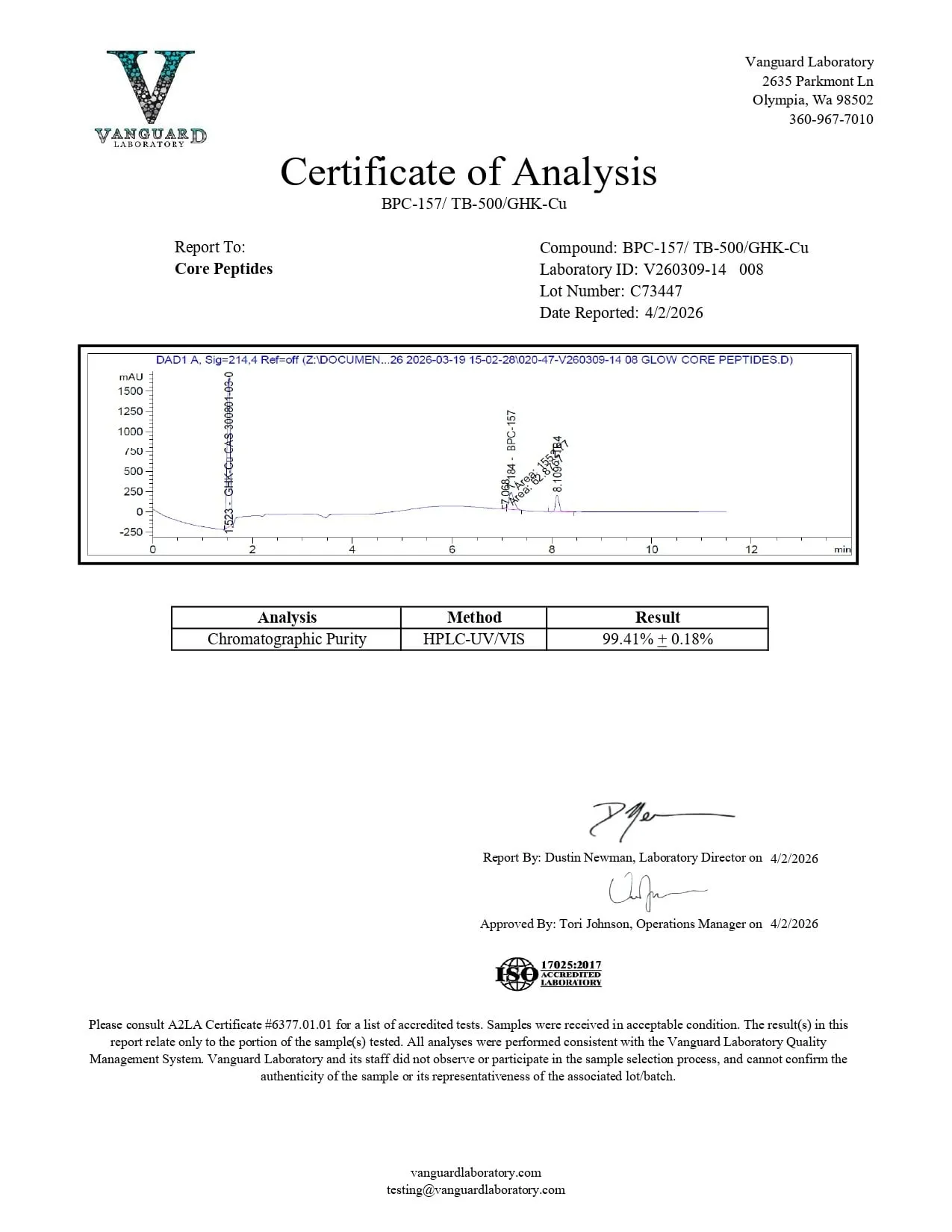
BPC-157 & TB-500 & GHK-Cu Blend 70mg
€270.00
BPC 157 TB500 Blend — Proven Triple Peptide Healing Research 70mg
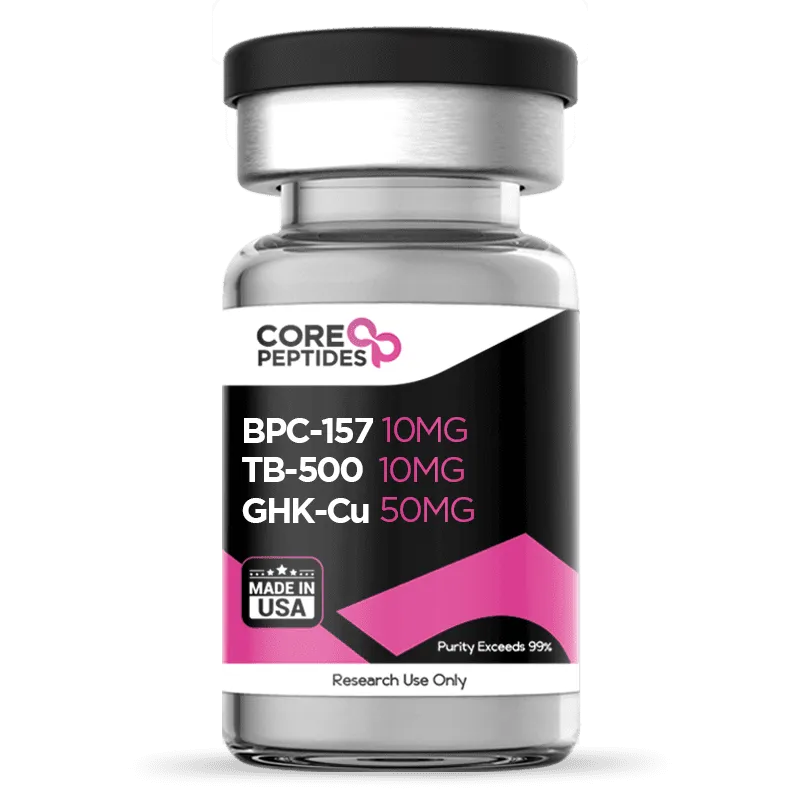
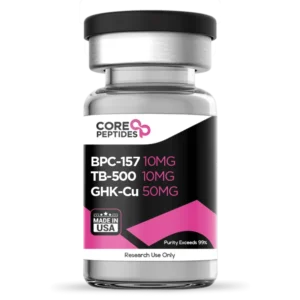
The bpc 157 tb500 blend with GHK-Cu represents a precision-formulated research preparation combining three of the most extensively studied healing and regenerative peptides in a single 70mg lyophilised vial. BPC-157 (10mg) provides its characterised angiogenic and anti-inflammatory research activity. TB-500 (10mg) contributes its actin-binding cell migration and tissue repair profile. GHK-Cu (50mg) adds its well-documented collagen synthesis, DNA repair and cell-protective properties. Each component has been individually validated at >99% purity — and together they constitute a research blend of exceptional mechanistic breadth. Supplied as a lyophilised powder for in-vitro scientific research.
⚠️ Research Use Only. This product is intended exclusively for in-vitro scientific research. It is not approved for human or animal consumption, clinical use, or therapeutic application.
Table of Contents
- Product Specifications
- BPC-157 Component Profile
- TB-500 Component Profile
- GHK-Cu Component Profile
- Synergistic Research Rationale
- Research Applications
- Reconstitution and Storage
- FAQ
Product Specifications
| Parameter | Detail |
|---|---|
| Blend | BPC-157 & TB-500 & GHK-Cu |
| Total Quantity | 70mg |
| BPC-157 | 10mg |
| TB-500 (Thymosin Beta-4) | 10mg |
| GHK-Cu (Copper Peptide) | 50mg |
| Unit | 1 Vial |
| Form | Lyophilised powder |
| Purity | >99% |
| SKU | BPC-157-TB-500-GHK-Cu-70mg |
BPC-157 Component Profile
BPC-157 — Body Protection Compound 157 — is a distinct synthetic peptide composed of fifteen amino acids, considered to originate from a fragment of a gastric protein. Research models indicate that it may interact with intracellular signalling systems relevant to vascular growth via angiogenic signalling and inflammatory regulation through attenuation of pro-inflammatory pathways.
As the angiogenic and anti-inflammatory component of this tb 500 and bpc 157 research blend, BPC-157 contributes a mechanistic profile relevant to vascular repair, tissue perfusion and inflammatory resolution — three processes fundamental to the healing research applications this blend addresses.
TB-500 Component Profile
TB-500 is a synthetic peptide identical in structure to the 43-amino-acid sequence of endogenous Thymosin Beta-4. In-vitro studies indicate that exposure to TB-500 may support cell movement and structural coordination through actin-binding activity, and may also participate in signalling pathways linked to angiogenesis and modulation of inflammatory mediators.
As the cell migration and cytoskeletal organisation component of this bpc 157 tb 500 peptide blend, TB-500 contributes its characterised capacity to promote the cellular movement and structural coordination essential to tissue repair — complementing BPC-157’s vascular and anti-inflammatory activity through a distinct mechanistic axis.
GHK-Cu Component Profile
GHK-Cu — the copper complex of glycyl-L-histidyl-L-lysine — is a naturally occurring tripeptide present in human plasma that coordinates a Cu²⁺ ion to produce biologically active copper-peptide complex. At 50mg, it constitutes the largest component of this blend by weight — reflecting its well-documented roles in collagen and elastin synthesis stimulation, fibroblast activation, DNA repair gene upregulation, NFκB suppression and cell-protective anti-inflammatory activity.
The blue colouration of the reconstituted blend solution is expected and arises from the GHK-Cu copper coordination — this is a standard property of copper-peptide complexes and confirms compound integrity.
Synergistic Research Rationale
The mechanistic rationale for combining bpc157 tb500 with GHK-Cu in a single research preparation rests on the complementary and non-overlapping nature of their primary activity profiles.
BPC-157 addresses angiogenic signalling and inflammatory pathway modulation — the vascular and immune regulatory dimensions of tissue repair. TB-500 addresses actin-mediated cell migration and cytoskeletal organisation — the cellular motility dimension of repair that drives wound closure and tissue reconstitution. GHK-Cu addresses extracellular matrix synthesis, DNA repair and cell-protective mechanisms — the structural and genomic dimensions of tissue restoration.
Together, these three components cover the primary mechanistic domains of comprehensive tissue repair biology — vascular, cellular and structural — in a single blend that provides research utility across a broader mechanistic range than any individual component achieves alone.
Research Applications
This blend is investigated within the following approved in-vitro research domains:
- Combined angiogenic and cell migration research
- Multi-mechanism wound healing biology
- Collagen, elastin and ECM synthesis alongside vascular repair
- Anti-inflammatory pathway modulation across multiple mechanisms
- DNA repair gene upregulation combined with tissue repair research
- Comparative blend vs individual component activity studies
- Comprehensive tissue protection mechanism investigation
Reconstitution and Storage
Reconstitute with sterile or bacteriostatic water. The reconstituted solution will exhibit blue colouration from the GHK-Cu component — this is expected and normal. Add solvent slowly along the vial wall and allow to dissolve by gentle rotation. Do not shake or vortex.
Store lyophilised powder at −20°C. Once reconstituted, maintain at 4°C and use within the timeframe specified by your research protocol. Avoid copper-chelating agents in reconstitution buffers. Protect from light and avoid repeated freeze-thaw cycles.
Explore individual components and additional healing research compounds in our Healing, Anti-Age and Longevity research categories.
FAQ
What is the BPC 157 TB500 blend with GHK-Cu? The BPC 157 TB500 blend with GHK-Cu is a 70mg lyophilised research preparation combining three distinct peptides — BPC-157 (10mg), TB-500 / Thymosin Beta-4 (10mg) and GHK-Cu copper peptide (50mg) — in a single vial at >99% purity. Each component brings a distinct mechanistic profile: BPC-157 for angiogenic and anti-inflammatory research, TB-500 for actin-mediated cell migration and TB-500 cytoskeletal research, and GHK-Cu for collagen synthesis, DNA repair and cell-protective biology. For in-vitro scientific research only.
What does the TB 500 and BPC 157 combination contribute in research? TB 500 and BPC 157 address complementary mechanistic dimensions of tissue repair research. BPC-157 engages angiogenic signalling and pro-inflammatory pathway attenuation. TB-500 engages actin-binding cell migration, cytoskeletal organisation and angiogenic signalling through its Thymosin Beta-4 activity. Together, the bpc 157 tb 500 peptide combination covers vascular, cellular and structural repair mechanisms — with GHK-Cu adding ECM synthesis and DNA repair dimensions to produce a comprehensive multi-mechanism research preparation.
What is the significance of GHK-Cu in this blend? GHK-Cu constitutes 50mg of the 70mg total blend — the largest component by weight. Its copper-coordinated tripeptide structure contributes collagen and elastin synthesis stimulation, fibroblast activation, NFκB suppression, proteasome enhancement and DNA repair gene upregulation to the blend’s overall research profile. These mechanisms address the extracellular matrix and genomic dimensions of tissue healing that the BPC-157 and TB-500 components do not directly cover.
What is the bpc-157 tb-500 blend supplement dosage timing in research? bpc-157 tb-500 blend supplement dosage timing as investigated in research protocols varies substantially by experimental model, administration route and target endpoint. This product is supplied for in-vitro scientific research use only — no therapeutic, supplement or personal dosage or timing recommendation is made or implied. Researchers should derive all protocol parameters from peer-reviewed literature and approved institutional frameworks. The term “supplement” does not apply to this research compound.
Why does the reconstituted blend appear blue? The blue colouration of the reconstituted BPC157 TB500 blend solution arises from the GHK-Cu component — the copper ion coordinated within the GHK-Cu tripeptide characteristically imparts blue colouration to copper-peptide complex solutions. This is a standard chemical property of divalent copper coordination and confirms that the GHK-Cu component is intact and properly dissolved in the reconstituted preparation.
Is this blend more research-relevant than individual components? For research protocols investigating multi-mechanism tissue repair biology — where the interaction between angiogenic, cell migration and ECM synthesis pathways is the focus — the bpc157 tb500 GHK-Cu blend provides research utility not achievable by studying any single component in isolation. For mechanistic research designed to characterise a single compound’s activity, individual component preparations remain the appropriate research tool.
2 reviews for BPC-157 & TB-500 & GHK-Cu Blend 70mg
Add a review
Related products
Healing and Regeneration research
Healing and Regeneration research
Longevity and Anti-aging Research
Longevity and Anti-aging Research
Core Peptides
Reproductive Health Research
Cognitive Enhancement Research
Particle Peptides
zoritoler imol –
I went over this site and I conceive you have a lot of great information, bookmarked (:.
arderborelnot –
Some really excellent info , Sword lily I observed this. “The language of friendship is not words but meanings.” by Henry David Thoreau.