

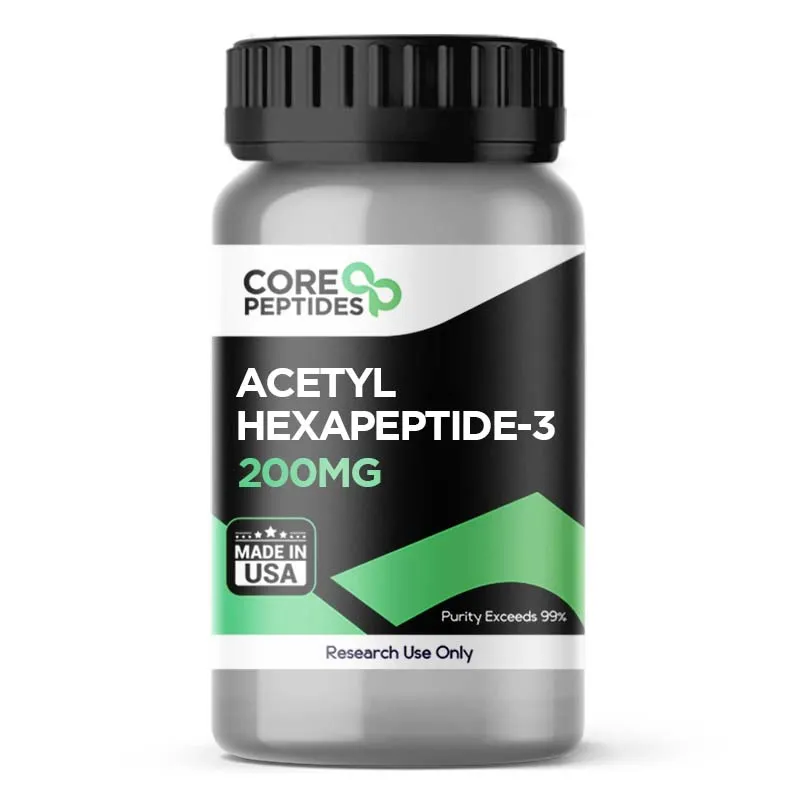
Acetyl Hexapeptide-3 (Argireline) 200mg
€203.40
Acetyl Hexapeptide-3 — Proven Anti-Age Research Peptide 200mg
Acetyl hexapeptide-3 — also widely referenced as Argireline — is a synthetic hexapeptide engineered as a competitive inhibitor of SNAP-25 (synaptosome-associated protein 25 kDa). This compound has been extensively researched for its potential action in reducing wrinkle formation in skin tissue through modulation of neuromuscular signalling pathways. Supplied as a lyophilised powder in a single 200mg vial with a verified purity of >99%, this compound is formulated to the exacting standards required for in-vitro scientific research.
⚠️ Research Use Only. This product is intended exclusively for in-vitro scientific research. It is not approved for human or animal consumption, clinical use, or therapeutic application.
Table of Contents
- Product Specifications
- Molecular Mechanism — SNAP-25 Inhibition
- SNARE Complex and Exocytosis Research Context
- Research Applications
- Reconstitution and Storage
- FAQ
Product Specifications
| Parameter | Detail |
|---|---|
| Peptide | Acetyl Hexapeptide-3 (Argireline) |
| Quantity | 200mg |
| Unit | 1 Vial |
| Form | Lyophilised powder |
| Purity | >99% |
| SKU | P-ACETYL-HEXAPEPTIDE-3 |
Molecular Mechanism — SNAP-25 Inhibition
Acetyl hexapeptide 3 was developed as a competitive inhibitor of SNAP-25 — a 25 kDa synaptosome-associated protein that serves as an essential structural component of the SNARE complex.
The basis for this inhibitory activity lies in the structural similarity between the N-terminal amino acid sequence of SNAP-25 and the amino acid sequence of acetyl hexapeptide-3 itself. This sequence homology enables the peptide to compete with SNAP-25 for incorporation into the SNARE complex — effectively blocking the assembly of functional SNARE architecture.
The SNARE complex is a central regulator of synaptic vesicle exocytosis — the calcium-dependent release of signalling molecules at the neuromuscular junction. When SNARE complex formation is disrupted by competitive SNAP-25 inhibition, exocytosis is impaired, reducing the release of acetylcholine — the primary neurotransmitter mediating nerve-to-muscle communication and muscle contraction.
This mechanism is the molecular basis for the compound’s investigation in wrinkle formation research, where acetylcholine-mediated muscle contraction in facial tissue is associated with the progressive formation of expression lines.
SNARE Complex and Exocytosis Research Context
The SNARE (Soluble N-ethylmaleimide Sensitive Factor Attachment Protein Receptor) complex is one of the most extensively studied molecular machines in cell biology. Its role in vesicle docking, fusion and neurotransmitter release makes it a research target of broad significance across neuroscience, dermatology and cellular signalling research.
SNAP-25 is one of three core SNARE proteins — alongside syntaxin and VAMP/synaptobrevin — required for functional vesicle fusion. The selective inhibition of SNAP-25 through peptide competition represents a pharmacologically precise approach to modulating exocytosis without the systemic effects associated with other inhibitory mechanisms.
Acetyl hexapeptide-3’s selectivity for SNAP-25 has made it a research tool of interest not only in dermatological wrinkle biology but also in broader investigations of neuromuscular signalling and cellular communication pathways.
Research Applications
Acetyl hexapeptide-3 is investigated within the following approved in-vitro research domains:
- SNAP-25 competitive inhibition studies
- SNARE complex assembly and disassembly research
- Synaptic vesicle exocytosis regulation
- Acetylcholine release and neuromuscular junction signalling
- Wrinkle formation and skin tissue biology research
- Dermatological anti-aging mechanism investigation
- Neurotransmitter release modulation studies
- Cellular communication and signalling pathway research
Reconstitution and Storage
Reconstitute following standard lyophilised peptide protocols appropriate to your research application. Store lyophilised material at −20°C. Once reconstituted, maintain at 4°C and protect from light. Avoid repeated freeze-thaw cycles to preserve peptide integrity.
Explore additional anti-aging and longevity research peptides in our Anti-Age, Longevity and Anti-Age and Healing research categories.
FAQ
What is acetyl hexapeptide-3? Acetyl hexapeptide-3 — also known as Argireline — is a synthetic hexapeptide developed as a competitive inhibitor of SNAP-25, a key component of the SNARE complex involved in synaptic vesicle exocytosis. By disrupting SNARE complex formation, it is hypothesised to reduce acetylcholine release at the neuromuscular junction — the mechanism under investigation in wrinkle formation and skin tissue biology research. Supplied as a 200mg lyophilised powder with >99% purity for in-vitro scientific research.
What is the difference between acetyl hexapeptide 3 and Argireline? Acetyl hexapeptide 3 and Argireline refer to the same compound — Argireline is the trade name under which this synthetic SNAP-25 inhibitor peptide has been commercially referenced, particularly in cosmetic research contexts. Both designations describe an identical molecular structure researched for neuromuscular signalling modulation and wrinkle biology.
How does acetyl hexapeptide-3 inhibit SNAP-25? Acetyl hexapeptide-3 inhibits SNAP-25 through competitive inhibition based on structural mimicry. The amino acid sequence of the peptide shares similarity with the N-terminal domain of SNAP-25 — allowing it to compete for incorporation into the SNARE complex. By occupying the SNAP-25 binding site in the SNARE architecture, the peptide prevents proper SNARE complex formation and impairs the downstream calcium-dependent exocytosis of neurotransmitters including acetylcholine.
What is the SNARE complex and why is it relevant to this research? The SNARE complex is a molecular machine composed of SNAP-25, syntaxin and VAMP/synaptobrevin that mediates synaptic vesicle fusion and neurotransmitter release at the neuromuscular junction. Its calcium-dependent exocytosis function is central to nerve-muscle communication and muscle contraction. Acetyl hexapeptide-3 targets SNAP-25 within this complex — making SNARE biology directly relevant to understanding the compound’s proposed mechanism and its investigation in wrinkle formation research.
What research applications is acetyl hexapeptide-3 used for? Acetyl hexapeptide-3 is used in approved in-vitro research examining SNAP-25 competitive inhibition, SNARE complex assembly dynamics, synaptic vesicle exocytosis regulation, acetylcholine release modulation, neuromuscular signalling pathways and dermatological wrinkle formation mechanisms. All applications are within approved in-vitro research frameworks. This compound is not approved for human administration or cosmetic use.
2 reviews for Acetyl Hexapeptide-3 (Argireline) 200mg
Add a review
Related products
Core Peptides

Core Peptides
Muscle Growth research

Core Peptides
Longevity and Anti-aging Research
Weight Loss Research

Longevity and Anti-aging Research
Particle Peptides
zimerov ertover –
Oh my goodness! a tremendous article dude. Thank you Nonetheless I am experiencing difficulty with ur rss . Don’t know why Unable to subscribe to it. Is there anyone getting similar rss downside? Anybody who knows kindly respond. Thnkx
arderborelnot –
Some really nice stuff on this website , I enjoy it.