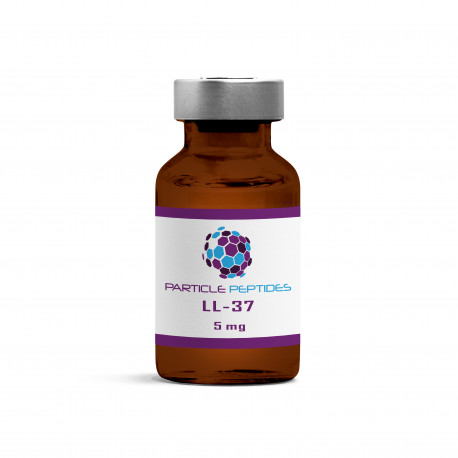
LL-37 (CAP-18) 5mg
€71.99
LL 37 Peptide — Essential Human Cathelicidin Research Compound 5mg
LL 37 peptide — also designated CAP-18 — holds a unique position in human immunology research as the only known human cathelicidin: a class of antimicrobial peptides with critical roles in innate immunity. This 37-amino-acid peptide exhibits a remarkably broad range of biological activities spanning antibacterial, antiviral, immunomodulatory and anti-inflammatory domains — making it one of the most biologically versatile research peptides currently available. Intensive biomedical research has established its significance across autoimmune disease biology, cancer research and wound healing investigation. Supplied as a lyophilised white powder in a single 5mg vial with a verified purity of ≥99%, this compound is manufactured to the exacting standards required for advanced in-vitro scientific research.
⚠️ Research Use Only. This product is intended exclusively for in-vitro scientific research. It is not approved for human or animal consumption, clinical use, or therapeutic application.
Table of Contents
- Product Specifications
- Cathelicidin Biology and Unique Status
- Antimicrobial Research Profile
- Immunomodulatory and Anti-Inflammatory Research
- Cancer and Autoimmune Disease Research
- Wound Healing Research
- Research Applications
- Reconstitution and Storage
- FAQ
Product Specifications
| Parameter | Detail |
|---|---|
| Peptide | LL-37 (CAP-18) |
| Quantity | 5mg |
| Unit | 1 Vial |
| Physical Appearance | White powder |
| Salt Form | Acetate |
| Peptide Purity | ≥99% |
| Molecular Mass | 4,493.34 Da |
| CAS Number | 154947-66-7 |
| Solubility | Bacteriostatic water — 1ml/vial |
| Sequence | Leu-Leu-Gly-Asp-Phe-Phe-Arg-Lys-Ser-Lys-Glu-Lys-Ile-Gly-Lys-Glu-Phe-Lys-Arg-Ile-Val-Gln-Arg-Ile-Lys-Asp-Phe-Leu-Arg-Asn-Leu-Val-Pro-Arg-Thr-Glu-Ser |
Cathelicidin Biology and Unique Status
The designation of ll-37 peptide for sale as the only known human cathelicidin carries significant biological and research implications. Cathelicidins are a family of antimicrobial peptides produced as part of the innate immune defence system across a range of vertebrate species — but the human genome encodes only a single cathelicidin precursor protein (hCAP-18/CAMP), from which LL-37 is generated by proteolytic cleavage.
This singularity means that LL-37 bears the full weight of human cathelicidin-mediated innate immunity — a biological responsibility that has driven decades of intensive research into its structure, mechanism and therapeutic potential. Its two-letter, two-number designation reflects its structural properties: “LL” for the two leucine residues at the N-terminus, and “37” for the total residue count of the mature peptide.
The cathelicidin precursor hCAP-18 is expressed in neutrophils, epithelial cells, keratinocytes and various other cell types — with LL-37 released as the active antimicrobial fragment upon proteolytic processing. Its tissue distribution is broad, reflecting the diversity of innate immune defence contexts in which it operates.
Antimicrobial Research Profile
The antibacterial properties of ll 37 buy research compounds are among the most extensively characterised in the antimicrobial peptide literature. LL-37 employs multiple mechanisms of antibacterial action — distinguishing it from conventional antibiotics with single targets and reducing the likelihood of resistance development in research model organisms.
The primary antibacterial mechanism involves disruption of bacterial membrane integrity — the positively charged, amphipathic helical structure of LL-37 at physiological conditions enables it to interact preferentially with the negatively charged bacterial membrane surfaces. This electrostatic interaction drives membrane insertion, disruption and ultimately bacteriolysis in susceptible organisms.
Antiviral research has characterised LL-37 activity against multiple viral families — with mechanisms involving both direct viral particle disruption and immunomodulatory antiviral signalling. Its antiviral activity profile makes it a research compound of broad interest in innate antiviral immunity investigation.
Biofilm disruption research represents a further dimension of LL-37’s antimicrobial profile — with research examining its capacity to inhibit biofilm formation and disrupt established biofilms in clinically relevant bacterial species, an application area of significant research importance given the role of biofilms in chronic infection.
Immunomodulatory and Anti-Inflammatory Research
Beyond direct antimicrobial activity, ll37 peptide dosage investigation in immunomodulatory research contexts has revealed a complex interaction with both innate and adaptive immune systems.
Chemokine and cytokine modulation has been characterised — LL-37 influences the expression and secretion of multiple immune mediators, shaping the inflammatory microenvironment at sites of infection or tissue damage. This immunomodulatory activity includes both pro-inflammatory effects in acute infection contexts and anti-inflammatory effects in chronic inflammatory disease models — reflecting the context-dependent nature of its immune regulatory activity.
Neutrophil, macrophage and dendritic cell activation has been investigated — with LL-37 demonstrating capacity to modulate the function of these innate immune effector cells in ways that influence pathogen clearance and inflammatory resolution.
TLR (Toll-like receptor) pathway modulation — both activation and inhibition depending on context — has been characterised as a key immunomodulatory mechanism, providing a molecular basis for the context-dependent anti-inflammatory effects observed in chronic inflammatory disease research models.
Cancer and Autoimmune Disease Research
The cancer research profile of ll 37 benefits investigation is multifaceted — with findings characterised across both potential tumour-suppressive and tumour-promoting activities, reflecting the context-dependence of LL-37’s biological effects.
Tumour cell apoptosis induction has been documented in multiple cancer cell line models — with LL-37’s membrane-disrupting properties proposed as a mechanism by which it may preferentially engage the altered membrane composition of cancer cells.
Autoimmune disease research has examined LL-37’s role in autoimmune pathogenesis — particularly in conditions including lupus erythematosus and psoriasis, where dysregulated LL-37 expression has been implicated in driving pathological immune activation. Understanding these mechanisms informs both disease biology and potential intervention research.
Wound Healing Research
Wound healing research involving LL-37 has characterised its capacity to accelerate epithelial repair, stimulate keratinocyte migration and proliferation, and modulate the inflammatory phase of wound healing in a manner that promotes resolution rather than chronic inflammation.
These wound healing properties operate in concert with LL-37’s antimicrobial activity — reducing microbial load at wound sites while simultaneously promoting the cellular repair processes required for complete tissue restoration. This dual antimicrobial and pro-healing activity profile makes LL-37 a research compound of particular interest in chronic wound biology where infection and impaired healing converge.
Research Applications
LL-37 is investigated within the following approved in-vitro research domains:
- Antibacterial mechanism and membrane disruption studies
- Antiviral innate immunity research
- Biofilm formation inhibition and disruption
- Immunomodulatory cytokine and chemokine regulation
- TLR pathway activation and inhibition research
- Neutrophil, macrophage and dendritic cell function studies
- Cancer cell apoptosis and tumour biology research
- Autoimmune disease pathogenesis investigation
- Wound healing and keratinocyte biology
- Innate and adaptive immune system interaction studies
- Anti-inflammatory mechanism research in chronic inflammatory models
Reconstitution and Storage
Reconstitute with bacteriostatic water at 1ml per vial. Add solvent slowly along the vial wall and allow to dissolve by gentle rotation. LL-37 is an amphipathic peptide that may exhibit self-aggregation at higher concentrations — prepare working solutions at appropriate concentrations for your assay system.
Store lyophilised powder at −20°C. Once reconstituted, maintain at 4°C and use promptly. Protect from light and avoid repeated freeze-thaw cycles.
Explore additional antimicrobial and immunity research compounds in our Anti-Age, Immunity and Healing research categories.
FAQ
What is LL 37 peptide? LL 37 peptide — also known as CAP-18 — is the only known human cathelicidin antimicrobial peptide, produced from the precursor hCAP-18 by proteolytic cleavage. It is a 37-amino-acid peptide with broad biological activity spanning antibacterial and antiviral mechanisms, immunomodulatory and anti-inflammatory properties, cancer biology relevance, autoimmune disease research and wound healing investigation. Supplied as a 5mg lyophilised white powder with ≥99% purity for in-vitro scientific research.
What are LL 37 peptide dosage parameters in research? LL 37 peptide dosage in published research varies substantially by application — antibacterial minimum inhibitory concentration studies, cell-based immunomodulatory assays and wound healing models each use different concentration ranges appropriate to their specific endpoints. This compound is supplied for in-vitro research use only — no therapeutic or personal dosage recommendation is made or implied. Investigators should reference peer-reviewed literature and approved institutional protocols.
Is LL-37 peptide for sale for human use? LL-37 peptide for sale through this platform is supplied exclusively for in-vitro scientific research. It is not approved for human administration, therapeutic use or clinical application. All research involving this compound should comply with applicable institutional and regulatory requirements.
What are LL 37 benefits characterised in research? LL 37 benefits characterised in in-vitro and preclinical research include antibacterial activity through membrane disruption, antiviral innate immune defence, biofilm inhibition, immunomodulatory cytokine regulation, TLR pathway modulation, wound healing acceleration, keratinocyte migration stimulation and anti-cancer apoptotic activity in cancer cell line models. These benefits are research findings — this compound is not approved for human therapeutic use.
What is LL37 peptide dosage in antibacterial research? LL37 peptide dosage in antibacterial research is typically expressed as minimum inhibitory concentration (MIC) values — the lowest concentration that inhibits visible growth of a test organism under specified conditions. MIC values for LL-37 vary by target organism, growth conditions and media composition. Researchers should reference published MIC data for their specific target organisms and replicate assay conditions precisely to obtain comparable results.
Why is LL-37 the only human cathelicidin? The human genome encodes a single cathelicidin gene (CAMP) producing the precursor protein hCAP-18 — from which LL-37 is released by proteolytic processing. Many other vertebrate species encode multiple cathelicidin genes, providing broader antimicrobial peptide diversity. The evolutionary constraint on human cathelicidin diversity makes LL-37 uniquely important to human innate immunity research and has driven sustained scientific interest in understanding and potentially modulating its activity.
4 reviews for LL-37 (CAP-18) 5mg
Add a review
Related products
Core Peptides
Immunity Enhancement Research
Cognitive Enhancement Research
Core Peptides
Weight Loss Research
Core Peptides
Longevity and Anti-aging Research
Immunity Enhancement Research
zoritoler imol –
I as well as my friends were actually analyzing the great secrets found on your web site and then quickly came up with an awful feeling I had not thanked the website owner for those strategies. My men were absolutely excited to study them and already have in truth been loving these things. Appreciate your indeed being simply considerate and then for selecting certain ideal subject areas most people are really desperate to be aware of. My very own sincere apologies for not expressing appreciation to earlier.
💵 Top Up 169.03 USDC >> graph.org/BALANCE-3682444-USD-04-21-3?hs=235bb301af9a5bd8831fe5795eefc4cf& 💵 –
esymxs
zimerov ertover –
I enjoy what you guys tend to be up too. This sort of clever work and coverage! Keep up the great works guys I’ve incorporated you guys to my own blogroll.
arderborelnot –
A powerful share, I just given this onto a colleague who was doing just a little evaluation on this. And he in reality bought me breakfast because I discovered it for him.. smile. So let me reword that: Thnx for the treat! However yeah Thnkx for spending the time to discuss this, I feel strongly about it and love studying extra on this topic. If possible, as you become expertise, would you mind updating your blog with more particulars? It is extremely useful for me. Massive thumb up for this weblog post!