
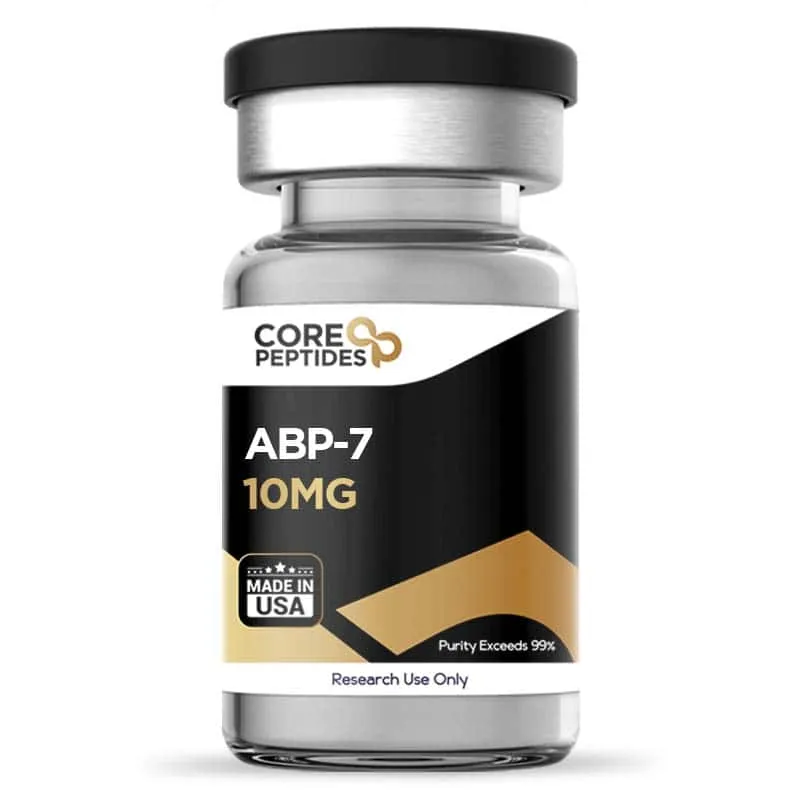
ABP-7 (Actin Binding Peptide-7) 10mg
€82.80
ABP-7 Peptide 10mg — Proven Thymosin Beta-4 Actin Fragment
ABP-7 peptide — actin binding peptide-7 — is a synthetic heptapeptide carrying the sequence Acetyl-LKKTETQ, representing the N-acylated 17-23 fragment of Thymosin Beta-4. Produced via solid-phase peptide synthesis, this seven-amino-acid sequence is considered by researchers to constitute the central actin-binding domain of the parent Thymosin Beta-4 molecule — the specific region through which Tβ4 exerts its G-actin sequestration activity. Supplied as a lyophilised powder in a single 10mg vial with a verified purity of >99%, this compound is formulated to the exacting standards required for in-vitro scientific research.
⚠️ Research Use Only. This product is intended exclusively for in-vitro scientific research. It is not approved for human or animal consumption, clinical use, or therapeutic application.
Table of Contents
- Product Specifications
- Relationship to Thymosin Beta-4
- Actin Binding Mechanism Research
- G-Actin Sequestration and Polymerisation
- Research Applications
- Reconstitution and Storage
- FAQ
Product Specifications
| Parameter | Detail |
|---|---|
| Peptide | ABP-7 (Actin Binding Peptide-7) |
| Sequence | Acetyl-LKKTETQ |
| Fragment Origin | Thymosin Beta-4 residues 17–23 |
| Quantity | 10mg |
| Unit | 1 Vial |
| Form | Lyophilised powder |
| Purity | >99% |
| SKU | P-ABP-7 |
| Synthesis | Solid-phase peptide synthesis |
Relationship to Thymosin Beta-4
ABP-7 occupies a precise position within the structural hierarchy of Thymosin Beta-4 research. The parent molecule — Thymosin Beta-4 (Tβ4), also supplied in research contexts as TB-500 — is a 43-amino-acid peptide with extensive characterisation as an actin-binding protein involved in tissue repair, wound healing and angiogenesis biology.
Within the Tβ4 sequence, the central domain — specifically residues 17 through 23 carrying the sequence LKKTETQ — is considered by researchers to be the primary actin-binding domain responsible for the parent molecule’s G-actin sequestration activity. ABP-7 for sale in research form provides this isolated domain as a standalone heptapeptide, enabling researchers to study actin-binding mechanisms with structural precision not achievable using the full 43-amino-acid sequence.
The N-acylation at the peptide’s N-terminus — producing the Acetyl-LKKTETQ form — mirrors the acetylated N-terminus found in the native Tβ4 molecule, preserving the chemical context of the actin-binding domain as it exists within the parent structure.
This fragment is also referenced in the research literature as a TB-500 fragment, given that TB-500 designates the synthetic preparation of Thymosin Beta-4 from which abp-7 peptide is derived.
Actin Binding Mechanism Research
The mechanistic basis for abp 7 peptide research interest lies in the fundamental biology of actin dynamics — one of the most extensively studied areas of cell biology.
Actin exists in two primary forms within the cell. G-actin (globular actin) is the monomeric, soluble form. F-actin (filamentous actin) is the polymeric form assembled from G-actin monomers through a process called actin polymerisation. The balance between G-actin and F-actin is tightly regulated within cells and is directly linked to cell motility, morphology, division and response to mechanical signals.
Thymosin Beta-4 — and by extension its central domain ABP-7 — functions as an actin-sequestering protein. By binding G-actin, it prevents incorporation of monomeric actin into growing F-actin filaments, thereby regulating the equilibrium between the two actin pools. ABP-7’s role as the domain through which this sequestration is mediated makes it the research focus of considerable interest in actin biology.
G-Actin Sequestration and Polymerisation
The specific mechanism under investigation for abp-7 peptide for sale research involves the inhibition of G-actin polymerisation into F-actin — a process termed actin sequestration.
When ABP-7 binds G-actin monomers, it effectively removes them from the available pool for polymerisation. This raises the intracellular concentration of G-actin while reducing F-actin assembly — a shift with direct consequences for cell motility, cytoskeletal organisation and the actin-dependent processes involved in wound healing, cell migration and tissue repair.
Research using isolated actin-binding domains like ABP-7 provides mechanistic clarity that full-length Tβ4 studies cannot always achieve — the contribution of the specific LKKTETQ domain can be characterised independently of the other functional regions of the parent molecule, enabling precise structure-activity relationship research.
Research Applications
ABP-7 is investigated within the following approved in-vitro research domains:
- Actin-binding domain characterisation and structure-activity studies
- G-actin sequestration and polymerisation inhibition research
- F-actin assembly regulation investigation
- Cell motility and cytoskeletal biology research
- Comparison with full-length Thymosin Beta-4 actin-binding activity
- Wound healing and tissue repair mechanism studies
- Cell migration and morphology research
Reconstitution and Storage
Reconstitute following standard lyophilised peptide protocols appropriate to your research application. Store lyophilised powder at −20°C. Once reconstituted, maintain at 4°C and use within the timeframe specified by your research protocol. Protect from light and avoid repeated freeze-thaw cycles.
Explore related actin biology and tissue repair research compounds in our Healing research category, including full-length Thymosin Beta-4 (TB-500) and other structural fragment preparations.
What is ABP-7 peptide? ABP-7 peptide — actin binding peptide-7 — is a synthetic heptapeptide with the sequence Acetyl-LKKTETQ, representing the N-acylated 17-23 fragment of Thymosin Beta-4. Researchers consider this sequence to be the central actin-binding domain of the parent Tβ4 molecule. It is produced via solid-phase peptide synthesis and supplied as a 10mg lyophilised powder with >99% purity for in-vitro scientific research examining actin-binding mechanisms, G-actin sequestration and cell motility biology.
What are ABP-7 peptide benefits characterised in research? ABP-7 peptide benefits characterised in research centre on its actin-binding activity — specifically its capacity to inhibit G-actin polymerisation into F-actin through sequestration of globular actin monomers. This sequestration mechanism is relevant to research examining cell motility, cytoskeletal organisation, wound healing and tissue repair biology. As the central actin-binding domain of Thymosin Beta-4, ABP-7 provides mechanistic precision for structure-activity relationship research not achievable with the full 43-amino-acid parent sequence.
Is ABP 7 for sale the same as TB-500? ABP-7 for sale is not the same compound as TB-500 — it is a specific fragment of the TB-500 / Thymosin Beta-4 parent sequence. TB-500 is the full 43-amino-acid Thymosin Beta-4 molecule. ABP-7 represents only residues 17–23 of that sequence — the LKKTETQ domain considered to be the primary actin-binding region. The two compounds are structurally distinct and are used for different research purposes — ABP-7 for mechanistic actin-binding domain research, TB-500 for investigation of the full-length peptide’s biological activity.
How does ABP-7 relate to Thymosin Beta-4 in actin biology? Within the Thymosin Beta-4 molecule, ABP-7’s LKKTETQ sequence constitutes the central actin-binding domain. This domain inhibits actin polymerisation by sequestering G-actin monomers — preventing their incorporation into F-actin filaments. By studying ABP-7 as an isolated fragment, researchers can characterise the specific contribution of this domain to Tβ4’s overall actin-regulatory activity with greater mechanistic precision than full-length molecule studies allow.
What is the significance of the Acetyl-LKKTETQ sequence? The Acetyl-LKKTETQ sequence of abp 7 peptide mirrors the chemical context of the LKKTETQ region as it exists within the native Thymosin Beta-4 molecule — where the N-terminus of the full peptide is also acetylated. This N-acylation is relevant to the actin-binding activity of the domain, as the chemical environment at the N-terminus influences the three-dimensional conformation of the binding region and its interaction with G-actin.
1 review for ABP-7 (Actin Binding Peptide-7) 10mg
Add a review
Related products
Reproductive Health Research
Core Peptides
Healing and Regeneration research
Longevity and Anti-aging Research
Healing and Regeneration research

Core Peptides
Reproductive Health Research
Healing and Regeneration research
zoritoler imol –
I as well conceive so , perfectly indited post! .