
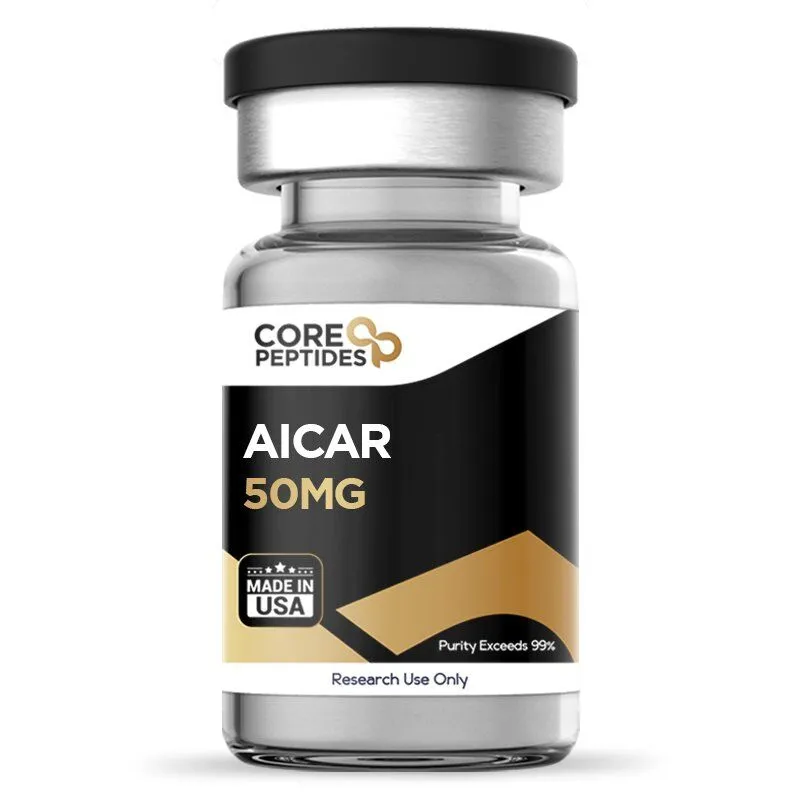
AICAR 50mg
€55.80
AICAR Peptide 50mg — Proven AMPK Activator Research Compound
AICAR — 5-Aminoimidazole-4-carboxamide ribonucleotide — is a synthetic analogue of adenosine monophosphate (AMP), a nucleotide central to cellular energy metabolism. As an AMP analogue, it activates AMP-activated protein kinase (AMPK) — a master regulatory enzyme that governs energy balance across multiple metabolic pathways. Widely studied for its potential in reducing reperfusion injury following tissue ischaemia and mitigating metabolic disorders, AICAR has established one of the most comprehensive AMPK research profiles of any compound in this category. Supplied as a lyophilised powder in a single 50mg vial with a verified purity of >99%, this compound is formulated to the precise standards required for in-vitro scientific research.
⚠️ Research Use Only. This product is intended exclusively for in-vitro scientific research. It is not approved for human or animal consumption, clinical use, or therapeutic application.
Table of Contents
- Product Specifications
- AMPK — The Master Metabolic Regulator
- Metabolic Research Applications
- Ischaemia Reperfusion and Tissue Protection Research
- Autophagy and Mitochondrial Biogenesis Research
- Research Applications
- Reconstitution and Storage
- FAQ
Product Specifications
| Parameter | Detail |
|---|---|
| Compound | AICAR (5-Aminoimidazole-4-carboxamide ribonucleotide) |
| Classification | AMP Analogue / AMPK Activator |
| Quantity | 50mg |
| Unit | 1 Vial |
| Form | Lyophilised powder |
| Purity | >99% |
| SKU | P-AICAR |
AMPK — The Master Metabolic Regulator
AICAR exerts its primary research activity through activation of AMP-activated protein kinase — AMPK — an enzyme that functions as a central sensor and regulator of cellular energy status. AMPK activation occurs naturally when the AMP-to-ATP ratio in the cell rises — signalling an energy-depleted state that requires metabolic adjustment to restore energy balance.
By acting as an AMP analogue, aicar for sale in research form mimics this energy-depleted signal, activating AMPK in a controlled and reproducible manner without requiring actual cellular energy depletion. This pharmacological AMPK activation is the mechanistic basis for AICAR’s research utility across metabolic, cardiovascular and cellular biology domains.
AMPK activation initiates a coordinated metabolic response designed to restore energy balance. This response involves two parallel mechanisms — inhibition of anabolic (energy-consuming) pathways and activation of catabolic (energy-generating) pathways — producing a net shift in cellular metabolism toward increased ATP generation.
Metabolic Research Applications
The metabolic research profile of buy aicar compounds is built on AMPK’s well-characterised role in regulating glucose and lipid metabolism.
On the catabolic side, AMPK activation stimulates glucose uptake and glycolysis, fatty acid oxidation and mitochondrial ATP production. These pathways collectively increase the rate of energy generation from available substrates — the primary short-term response to cellular energy deficit.
On the anabolic side, AMPK inhibits protein synthesis, fatty acid synthesis and cholesterol synthesis — energy-consuming processes that are appropriately suppressed during periods of energy deficit. This inhibition is directly relevant to metabolic disorder research, where inappropriate persistence of anabolic signalling despite inadequate energy availability contributes to insulin resistance, obesity-related metabolic dysfunction and related conditions.
The metabolic regulatory breadth of AMPK — and therefore buy aicar online research interest — has extended to investigation in type 2 diabetes models, obesity research and metabolic syndrome investigation, where AMPK’s role in restoring appropriate energy homeostasis is of direct mechanistic relevance.
Ischaemia Reperfusion and Tissue Protection Research
The most extensively studied non-metabolic application of aicar peptide research involves its potential to reduce reperfusion injury following tissue ischaemia — a research area of significant biomedical importance.
Ischaemia-reperfusion injury occurs when blood flow is restored to tissue after a period of oxygen deprivation — paradoxically causing additional cellular damage through oxidative burst, inflammatory cascade activation and mitochondrial dysfunction. Research has examined AICAR’s capacity to attenuate this injury through AMPK-mediated preconditioning mechanisms — reducing the cellular damage response that follows reperfusion in cardiac, neural and peripheral tissue models.
The cardioprotective implications of this research have driven sustained investigation into AICAR’s utility in cardiac ischaemia models — given the significance of reperfusion injury in myocardial infarction pathophysiology and the limited efficacy of current reperfusion injury mitigation strategies.
Autophagy and Mitochondrial Biogenesis Research
AMPK’s regulatory influence extends beyond acute metabolic balance to encompass longer-term cellular maintenance mechanisms — two of which are of particular research significance.
Autophagy — the cellular process by which damaged components, misfolded proteins and dysfunctional organelles are identified, sequestered and degraded — is activated downstream of AMPK in energy-depleted conditions. AICAR’s AMPK activation provides a pharmacological tool for investigating autophagy induction and its effects on cellular homeostasis, aging biology and disease model investigation.
Mitochondrial biogenesis — the creation of new mitochondria to expand cellular energy production capacity — is also promoted downstream of AMPK activation. Research examining AICAR’s effects on mitochondrial biogenesis is of direct relevance to metabolic disease investigation, exercise physiology research and aging biology where mitochondrial dysfunction is a primary pathological mechanism.
Research Applications
AICAR is investigated within the following approved in-vitro research domains:
- AMPK activation and energy sensing mechanism studies
- Glucose uptake and glycolysis regulation research
- Fatty acid oxidation and lipid metabolism investigation
- Protein and fatty acid synthesis inhibition research
- Ischaemia-reperfusion injury and tissue protection studies
- Cardiac preconditioning and cardioprotective mechanism research
- Autophagy induction and cellular homeostasis investigation
- Mitochondrial biogenesis and function research
- Inflammation and stress response pathway studies
- Type 2 diabetes and insulin resistance model investigation
- Obesity and metabolic syndrome research
Reconstitution and Storage
Reconstitute following standard lyophilised compound protocols appropriate to your research application. Store lyophilised powder at −20°C. Once reconstituted, maintain at 4°C and use within the timeframe specified by your research protocol. Protect from light and avoid repeated freeze-thaw cycles.
Explore additional metabolic and longevity research compounds in our Weight Loss, Longevity and Anti-Age and Healing research categories.
FAQ
What is AICAR peptide? AICAR is a synthetic analogue of adenosine monophosphate (AMP) that activates AMPK — the master cellular energy sensing enzyme. Widely studied for reducing reperfusion injury after tissue ischaemia and mitigating metabolic disorders, it works by mimicking the AMP signal of cellular energy depletion, triggering AMPK to inhibit anabolic pathways and activate catabolic energy-generating processes. Supplied as a 50mg lyophilised powder with >99% purity for in-vitro scientific research.
What are AICAR peptide benefits characterised in research? AICAR peptide benefits characterised in research include AMPK-mediated metabolic regulation — stimulating glucose uptake, fatty acid oxidation and ATP generation while inhibiting energy-consuming anabolic pathways. Additional benefits under investigation include ischaemia-reperfusion injury reduction, cardiac preconditioning, autophagy induction, mitochondrial biogenesis promotion and broad metabolic disorder investigation relevant to type 2 diabetes and obesity research. These are research findings — this compound is not approved for human use.
Where can I buy AICAR? Buy AICAR options are available through specialist research compound suppliers. This compound is supplied strictly for in-vitro scientific research. It is not approved for human consumption, therapeutic use or clinical application. Researchers should ensure compliance with all applicable institutional and regulatory requirements when procuring this compound.
Can I buy AICAR online for research? Buy AICAR online through specialist research peptide and compound suppliers who supply documented, >99% purity lyophilised preparations for in-vitro research use. Always verify purity documentation, batch testing and supplier credentials before procurement. This compound is for in-vitro research use only.
How does AICAR activate AMPK? AICAR is taken up by cells and converted intracellularly to AICA-ribonucleotide monophosphate (ZMP) — a compound that mimics AMP at the regulatory sites of AMPK. This AMP mimicry activates AMPK without requiring actual cellular ATP depletion, providing pharmacological AMPK activation in a controlled and reproducible research model. This mechanism makes AICAR one of the most widely used pharmacological tools for AMPK research in cell biology.
What is AICAR used for in ischaemia research? In ischaemia research, AICAR is used to investigate AMPK-mediated preconditioning mechanisms that may reduce reperfusion injury. Research has examined its capacity to attenuate the oxidative burst, inflammatory cascade and mitochondrial dysfunction that occur when blood flow is restored to ischaemic tissue. Cardioprotective applications in myocardial ischaemia models represent the most extensively investigated clinical research direction.
2 reviews for AICAR 50mg
Add a review
Related products
Core Peptides
Longevity and Anti-aging Research
Longevity and Anti-aging Research
Particle Peptides
Core Peptides
Longevity and Anti-aging Research
Longevity and Anti-aging Research
Healing and Regeneration research
vorbelutrioperbir –
Excellent post. I was checking continuously this blog and I am impressed! Extremely helpful information specifically the last part 🙂 I care for such information much. I was seeking this certain information for a very long time. Thank you and best of luck.
zimerov ertover –
Rattling good visual appeal on this internet site, I’d value it 10 10.